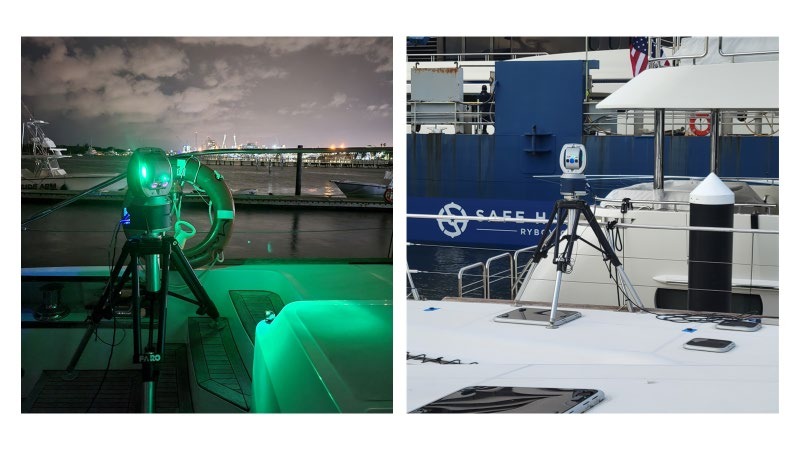
What a hull target measures, why it must precede driveline work, and what two South Florida haul-outs demonstrate.
A yacht afloat and the same yacht on blocks are two different shapes. In the water, buoyancy supports the hull along its length, on the dry dock, the vessel’s weight is concentrated on a limited number of keel blocks and side supports. Unless those supports reproduce the vessel’s designed load paths, the hull can distort, and every alignment reading taken in that condition describes a geometry the vessel will not retain once it floats.
Where the practice started
Nearly two decades ago at a South Florida shipyard, AME President Rich Merhige watched a yard crew check deck deflection using a tight piano wire strung along the deck. The thinking was right, the resolution wasn’t. AME had already moved its propulsion machinery alignment work to laser systems, and Rich began researching whether that same precision could be brought to hull targeting. As high-resolution laser straightness measurement matured, he introduced the method to South Florida haul-outs, where it has been part of AME’s alignment practice ever since.

Deflection and Alignment
A propulsion system is built on the assumption that the hull is in a known geometric condition. The shaft centerline, the struts, the bearings and the engine mounts all reference that geometry. When the hull deflects, the geometry moves with it. Put plainly, if the hull isn’t in its correct shape, any shaft alignment readings you take are wrong.
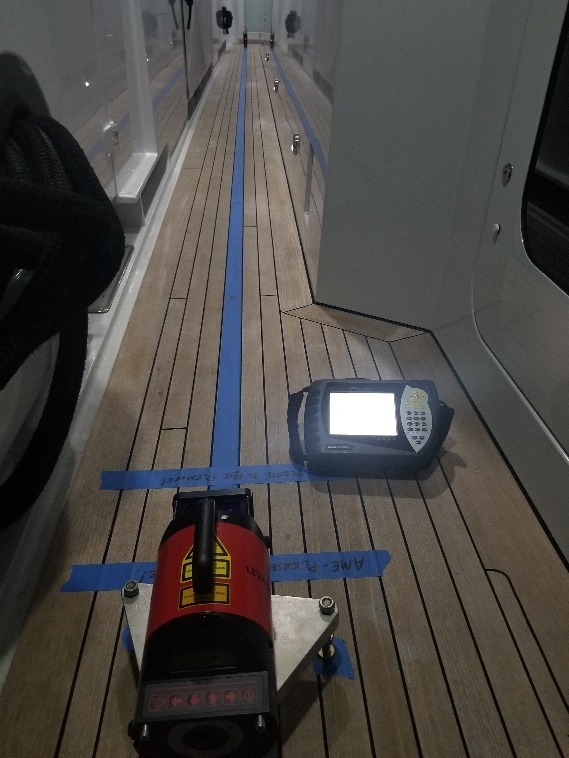
A hull target is a laser-referenced baseline of the vessel’s geometry. AME records that baseline while the vessel is waterborne at 50 percent liquid loads, then compares the same reference points as weight transfers to the blocks, at partial load and again at full load. The deck provides an accessible, repeatable reference surface. Deflection is controlled through a planned lift sequence, correct sling placement, synchronized lifting, and supports positioned to match the vessel’s designed load paths; the hull target verifies whether those measures preserved the vessel’s shape.

In the field: a 164-foot aluminum motor yacht
Both stern tubes had been renewed at another yard. When the shafts wouldn’t draw back into the vessel, the vessel’s insurer brought AME in. We targeted the deck afloat, again at 50 percent load on blocks, and again at full load. The hull held to less than a half millimeter of maximum deflection.
That tolerance ruled out blocking as the cause and confirmed that the optical findings represented the vessel’s true geometry. The actual problem was component alignment: the new stern tube had not been aligned to a true reference line through the bearing centers. Because no hull target had been performed before the renewal, the yard lacked a verified geometric baseline. The lesson is clear: hull targeting belongs on the schedule before major driveline work, not after it.
In the field: a 74-foot sailing catamaran
A multihull presents a different measurement question. Rather than focusing primarily on longitudinal hogging and sagging, the target must also capture athwartship deflection, whether the structure connecting the two hulls retains its shape out of the water. AME established reference points along both hulls and across the bow, aft deck, and transom. The team measured those points afloat and again after blocking. Deviation remained within a few millimeters, with no significant hogging or sagging in either direction, so no blocking adjustment was required. A clean result is still a valuable result. The yard moved forward on documentation rather than an assumption.
Remember: Do A Hull Target Before Hauling Out
Hauling for driveline work? Have the hull targeted before the job begins, not after the shafts won’t fit. Request a service today.