The more of a machinery driveline you can measure in the same moment, the less guesswork is left in the diagnosis. That principle sits behind AME’s advanced diagnostics work and the Dewesoft platform our field team runs it on.
Channel Surfing
Dewesoft is a modular data acquisition system. Hubs stack and synchronize together, so a survey scales to what the work requires, a single gearbox on a shop floor, or the 40 channels we recently ran across two main engines, two reduction gears and both flywheels of a towboat under way.
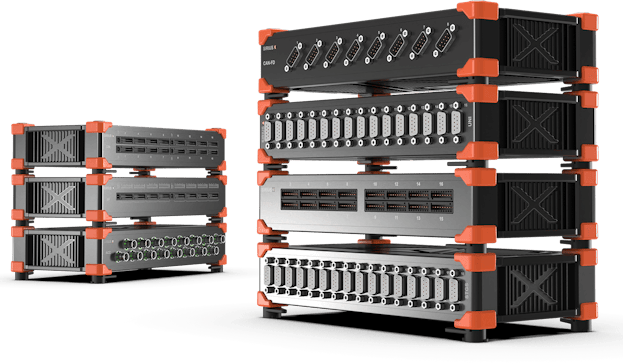 Dewesoft hubs stack and synchronize, scaling a survey to the channel count the job requires.
The platform accepts mixed sensor types on the same rack. Tri-axial accelerometers, laser tachometers, Hall effect sensors, strain gauges and encoders all feed one system. Our engineers configure the measurement before the first test runs, with spectrum, waveform and trend data on screen live, so a questionable channel shows itself while the team is still standing next to the machine.
Everything in Phase
Every channel lands on a common time base, resolved to fractional revolutions. Linear vibration, torsional vibration and shaft speed come back in one continuous record, so a peak on an accelerometer can be read against exactly what the shaft was doing at that instant. Order analysis then ties each peak to a rotating component, whether that’s firing frequency, blade pass or gear mesh.
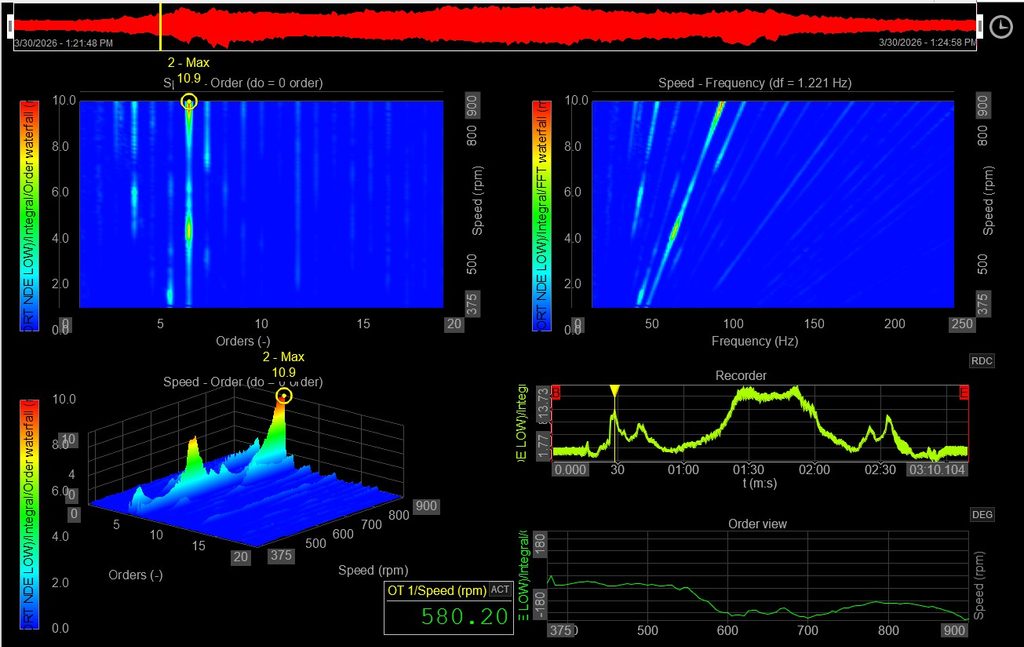 Waterfall spectra, overall trend and phase, recorded across a sweep from idle to wide-open throttle.
On the towboat we recorded a sweep from idle to wide-open throttle, a stepped test climbing in 50 RPM increments, and a steady-state run at full load, all while the vessel transited the river. Machinery under load behaves differently than machinery at the dock. Combustion torque and propeller thrust only develop fully once the boat is working.
A Twist in Every Revolution
Torsional vibration analysis is where the platform earns its keep. Reading a flywheel ring gear through Hall effect sensors, or a shaft through an encoder, Dewesoft resolves the rotational oscillation in a driveline, the speeding up and slowing down that happens within a single revolution. A housing-mounted accelerometer doesn’t capture that motion directly, which is how a driveline can pass a conventional vibration survey while a torsional problem keeps breaking parts.
Reading Between the Orders
The vessel came to AME with a history of flywheel failures following a repower. Linear vibration on both engines and reduction gears measured within ISO 20816 tolerance. On the conventional numbers, the machinery looked healthy.
Torsional data showed resonances on the starboard shaft running roughly three times the amplitude of port. Those readings sent our engineers back to the original torsional vibration analysis, which appeared to have modeled the propellers as free-running rather than inside their nozzles, and the engines at the low end of their horsepower rating.
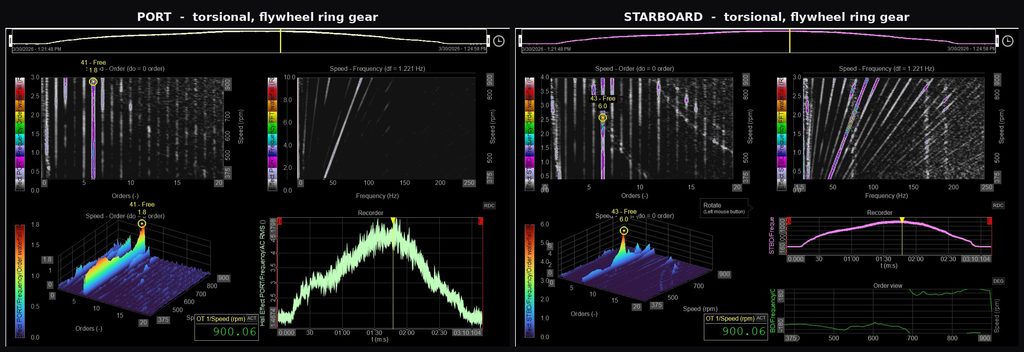 Torsional data from the flywheel ring gears, port and starboard, same sweep. Starboard amplitudes run roughly three times port.
Motion Carried
Video ran at the same time. Motion amplification, developed by RDI Technologies, processes high-resolution footage frame by frame and amplifies movement too small for the eye to catch. On this job it put pictures to the numbers: the flywheel and coupling assemblies hunting axially, the starboard reduction gear pitching at engine order, and the hull structure responding at blade-pass frequency.
 Motion amplification processes high-resolution video frame by frame to reveal movement too small for the eye to catch.
Useful for confirming a finding. Useful again when that finding has to be explained to someone who wasn’t on board.
Measuring everything at once shortens the path from symptom to cause. AME’s testing and analysis team provides torsional vibration analysis and full driveline surveys for marine and industrial machinery. Get in touch to discuss a survey on your equipment.